Note
Click here to download the full example code
Truncated Power Law Variograms
GSTools also implements truncated power law variograms,
which can be represented as a superposition of scale dependant modes
in form of standard variograms, which are truncated by
a lower-  and
an upper length-scale
and
an upper length-scale  .
.
This example shows the truncated power law (TPLStable) based on the
Stable covariance model and is given by
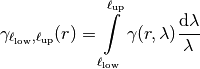
with Stable modes on each scale:
![\gamma(r,\lambda) &=
\sigma^2(\lambda)\cdot\left(1-
\exp\left[- \left(\frac{r}{\lambda}\right)^{\alpha}\right]
\right)\\
\sigma^2(\lambda) &= C\cdot\lambda^{2H}](../../_images/math/87c664a306319a704abb18269267e99c44d410f2.png)
which gives Gaussian modes for alpha=2
or Exponential modes for alpha=1.
For  this results in:
![\gamma_{\ell_{\mathrm{up}}}(r) &=
\sigma^2_{\ell_{\mathrm{up}}}\cdot\left(1-
\frac{2H}{\alpha} \cdot
E_{1+\frac{2H}{\alpha}}
\left[\left(\frac{r}{\ell_{\mathrm{up}}}\right)^{\alpha}\right]
\right) \\
\sigma^2_{\ell_{\mathrm{up}}} &=
C\cdot\frac{\ell_{\mathrm{up}}^{2H}}{2H}](../../_images/math/423d8fab9153272a1d569a91fa2197c5f73f3e42.png)
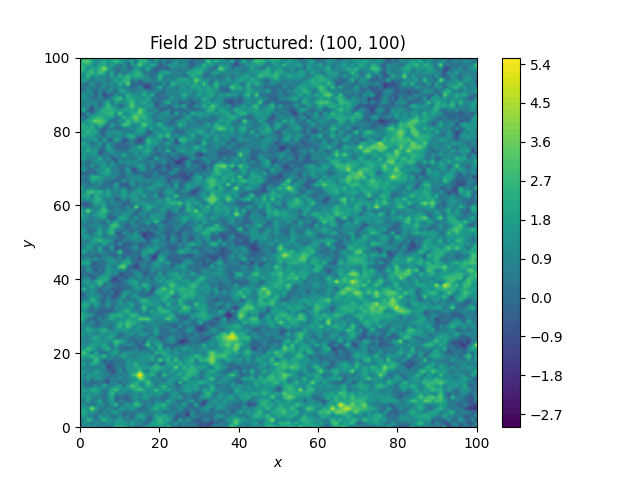
import numpy as np
import gstools as gs

x = y = np.linspace(0, 100, 100)
model = gs.TPLStable(
    dim=2,  # spatial dimension
    var=1,  # variance (C is calculated internally, so variance is actually 1)
    len_low=0,  # lower truncation of the power law
    len_scale=10,  # length scale (a.k.a. range), len_up = len_low + len_scale
    nugget=0.1,  # nugget
    anis=0.5,  # anisotropy between main direction and transversal ones
    angles=np.pi / 4,  # rotation angles
    alpha=1.5,  # shape parameter from the stable model
    hurst=0.7,  # hurst coefficient from the power law
)
srf = gs.SRF(model, mean=1.0, seed=19970221)
srf.structured([x, y])
srf.plot()
Total running time of the script: ( 0 minutes 15.190 seconds)